Know your dislikes, but do you know what you want to do?

It is very easy to know what I don’t like or don’t enjoy doing.  I don’t like mundane activities, processes that does not meet my standards of common sense, a manager who does not value add to my role and the list goes on and on.  It does not take any effort on my part to pin point what’s wrong and negative.  It does not take any effort to criticize the leaders in my organisation for their strategies or approach.  However, when the questions are rephrase as

  • “What do you like to do?”
  • “What solutions would you propose to solve a problem?”
  • “How would you do it differently if you had these 4 parameters and constraints to work within?”

What is your response?

When the tables are turned, and we are now in the position of having to come up with the solutions or answers, how would we handle the criticisms?

During any performance review or career discussion, one of the hardest topic of discussion is around “What does an employee want to do or enjoy doing or am passionate about?”  Most of the time, we know what we don’t want to do but very seldom do we know what we really want to do.  Without knowing the answer to what we really want to do will cause a number of issues such as:

  • Going in circles:  Moving from role to role hoping to find a role that you will enjoy doing.
  • Disappointments:   Disappointments are just around the corner because it is just easy to spot the negatives vs. the positives.  As you are unable to find what you like to do, expectations will take a hit and you will naturally feel disappointed.
  • Demotivation sets in:  Struggling to find an area that you enjoy or are passionate about will bring cause you to lose motivation to do the role that you are in.  One of the most common work plague is demotivation and it is contagious.  When one person is demotivated, everyone around will know it both from the words and actions.
  • Indifference:  At the end of the disappointment and demotivation journey, the attitude that will be born is Indifference.  It just does not matter.  It does not matter when I do a great job or not.  I will just do what I am paid to do.  Strive no more because what’s the point.

None of those attributes would be used to describe a satisfied and productive person.  If you find yourself in anyone of those category above, it may be time to take stock and uncover what it is that you want and enjoy doing.

Let’s start by asking yourself some foundational questions:

  • What are my values?
  • What are my strengths?
  • What is your life purpose?
  • What are my past achievements that I am proud of?
  • What type of role brings out the best in me?
  • What environment would bring out the best in me?
  • What drives or motivates me to get out of bed to achieve?

It might seem hard to even answer the first question but it is worth your while to do so.  It is hard to find alignment between what your values are and the role that you do if you don’t know either one of the answer to the equation.

I would encourage you to take the time to reflect and know for yourself especially alignment with your values and what you do as that’s one critical key in unlocking living out your potential.  This might be a hard task to take on your own, find a coach, a mentor, a friend, someone who is able to challenge you and keep you accountable.
6 ways to live Up to Your Potential

Potential, that’s term that we commonly hear.  Whether we are talking about a child or an employee or about you.  Questions are abound and it goes something like this:

  • What is your potential?
  • How do you know if you are living up to your potential?
  • How do you know if you have maxed out on your potential?
  • What can you do to develop your potential?

No doubt that these questions have been asked and you may have also come up with some answers of your own.  Some common answers would be

  • “I don’t know what my potential is?”
  • “I feel like I have reached the pinnacle of my potential.”
  • “I don’t want to know.”
  • “I am afraid to challenge myself.”

Is there a way for you and me to know for sure?  The first step is to know and understand what potential is and is not.  According to the Oxford Dictionary, potential is “having or showing the capacity to become or develop into something in the future.

Therefore potential is about:

  • An ability or skill or talent that you have and have demonstrated it in some behaviour or action.
  • It can be develop further, not stagnant and can grow and increase with usage and time.
  • It is forward looking.  It continues to grow if it is continuously being developed.
  • It is “alive”, waiting to be realised and desiring to grow.
  • Prospect of and for greater success.
  • There is always room for improvement.

Conversely potential is not about:

  • One time experience or achievement.
  • It is not past tense.
  • Being contented with where you are at.
  • Hiding it or putting a lid on your strengths or skills.

What can we do to living out our potential?  There are 6 ways to ensure that we live out and up to our potential:

  1. Forward Looking:  It is about the next step, the next milestone, the next goal, the next area of growth, always asking the question of “What’s Next?”.  It is forgetting what is behind or in the past, and striving to move forward with the aim of doing and being better.
  2. Say “Yes” to Challenges and “No” to Fear.  Growth only comes when there is resistance and challenges to be faced and overcome.  When an opportunity arises to push your skills or abilities further, take it on.  No matter what we do, there will always be fear involved.  No one goes through life without feeling fearful, but the one who overcomes fear will always come out of it having grown and learnt more than expected.
  3. Keep on keeping on.  When the going gets tough, the tough gets going.  It is all about perseverance and determination.  Once you have committed to a certain goal, be focus and stay the course.  It is easy to give up half way or even right before the end, and we all know the regret that comes from it.  It is with those past experience that should help us to remember that there is always a positive outcome if we never give up.  There is always experiences to be gained.
  4. Belief.  You must have the belief that this is the path that want to take.  You must believe that this is your purpose.  You must believe that this is your calling.  Belief is important to keep you keeping on.
  5. Vision of the outcome can be very different from how you start out. What you start out with may look very different from how it ends up.  There are those who are able to achieve exactly what they set out to.  Most of us will find that the achievements are different from what had envisioned.  However, it is always satisfying if it’s the working out of our potential.
  6. It is Not solely about the achievement but about Maturing.  
    • skills and abilities
    • emotional and mental maturity.


Where are you in the journey of living out your potential?  What would you do differently?  Where do you see your potential taking you?  What is holding you back?  What would propel you forward?

Potential is all about the future.  Don’t let the past failure or setback put a full stop on your potential.  Focus on the future and just how bright and promising it can be.

When “Insanity” Strikes

There are times when nothing that we do seem to be going right.  It just isn’t falling into place.  Why?  What is the reason?  You are doing the same thing that you have done in the past and yet now, it just isn’t working out.  What’s the deal here?

alberteinstein133991

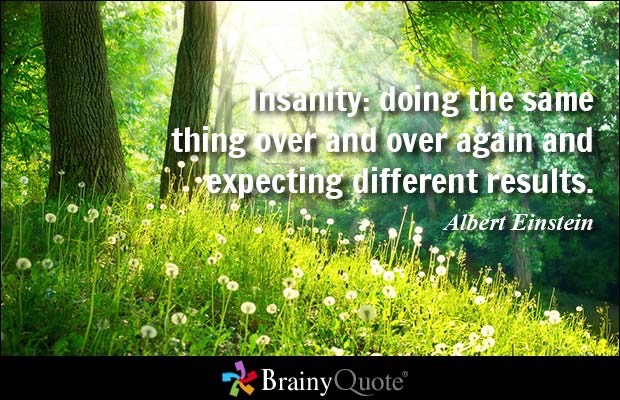
As Albert Eisntein famously said “Insanity is doing the same thing over and over again and expecting different results.”  But that goes against the motto of “practice makes perfect”.  After all, how can we master something if we are not doing the same thing over and over again.

I think that the key here is “expecting different results”.  The more we practice, the more we get better at doing a task and will result in improvements up to a certain point.  At that certain point, no matter how much more of the same practice we do, we are not going to improve upon the results as the resulting action brings about that certain range of results.  For example, it is different action plan from learning to run from a couch potato than it is from a jogger to a marathon runner or from lowering your personal best time if you don’t change your training plan.

If that’s the case, what can I do?  When do I know its time to tweak or make necessary changes?

To help you identify when its time to try something different is fairly straightforward.  Ask yourself:

  • When are not getting different results?
  • When did your expectations change to a different result?
  • What circumstances or situations have changed to cause a need for different results?

Once you have identified the change in the desired outcome, situation and cause of it, you can then set about thinking about what can you do to course correct.

How would you go about making changes, whether big or small?  The answer depends on what is the result that you are looking for.  Logically that would be slight changes for small changes in results and it would go proportionally.  Is that always the case?  The difficulty in answering that question lies within these 4 parameters:

  • Level of commitment
  • Level of difficulty
  • Level of desired result or outcome
  • Pressure of time

For example, if I am currently performing a certain task at level 7 and getting results of 8 and now I am told that I need to get it to a result of 9 with a long lead time, I will see that as achievable and therefore my level of commitment is high as the level of difficulty is not perceived as hard.  However, if I am told that I need to double the results to 16 within a short time frame, it might now seem unachievable.  I could give up even before starting.  Or alternatively, I could see it as a great motivation and hence increase my level of commitment towards changing how I have been performing certain task to achieve the new goal.  The dependencies of your success will be tied to the 4 parameters above and the changes to the action plans.

When you realize that “insanity” has struck you, you can make the necessary changes.  Start by asking yourself:

  • What is the new goal or desired outcome?
  • What is the required changes?
  • What can I still continue to do?
  • What do I need to do differently?
  • What help do I need to get?

For example, I have a goal for my golf game to score below 100.  My current average is 105.  To score 99, I just have to eliminate 6 strokes from my current level of play.  When I break down my strokes, it seems to me that if I could putt better, 6 strokes would not be an issue.  So what do I need to do differently?

  • My new goal is to score 99
  • Possible changes:  Putting technique or a different putter.  Might be cheaper to just tweak my putting technique and practice
  • Continue to do:  practice with current technique
  • DO differently:   practice with alignment rods
  • What help do I need:  golf coach or a friend to just watch my alignment

As you can see from the example above, each of us know,  in what area needs a change or improvement but most of the time we don’t do it because the inertia to move and make the change is too strong.

However, I am sure that no one wants to be labeled “insane”.  Hence to be “sane” try different ways of doing something and you will be pleasantly surprise with the results.  Change is not the enemy, “insanity” is.

3 Dangers of Not Moving On

The most common coaching topic that I have is around change and moving / transitioning to something new.  There are times when deep down inside you know that its time to move on.  Move on from your current role, change career, start another chapter in your life.  Whatever the transition that needs to take place but you are not making the change.  There are many reasons for not making the move and all of them are valid.  However, on the flip side, there are also risks and dangers for not moving on.

The top 3 dangers are:

  1. Fear Grows:  One of the common reason a majority of people do not make the move unless pushed is because of FEAR.  The longer we postpone a decision to change, we allow fear to grow.  Fear grows with time and comfort.  The risk factor grows with time too.  The longer we wait, the more we have to lose.  Fear take a life of its own and in some cases so paralysing that you are not able to see beyond it.  The reality of fear is that it is as big and as real as you make it to be.
  2. Settling for comfort:  There is nothing wrong with being comfortable but there is with settling for comfort.  Settling like compromise is basically saying to yourself that I don’t need to grow or to improve.  The effect of settling at a certain stage is we stop learning.  The impact is not just on yourself, the impact is on others as well.  When someone settles for something, there is a sense of security but that sense of security is very quickly and easily threatened by someone or something that rocks the boat.
  3. Insecurity grows:  At the back of our minds, we know when change is required.  We know when its time to move on.  We are resisting that move.  As a result, our insecurity will grow.  Insecurity  grows very much like fear.  We are insecure with our position and decisions.  The options available becomes smaller and it will feel like there is no way out.  In order to keep the security level, the rise of insecurity will cause 2 reactions:
    • To prevent the change.  A person will do almost anything to prevent the change from taking place.  Road blocks, resistance, negative excuses, are some form of how a person will respond.
    • To stop the object of the change.  A person will also do everything possible to stop the object of change.  The object of change could be a person or a situation.  To stop change from taking place, that person might tarnish or discredit the person who is initiating change.

These dangers will not just cause issue for the person, but also for people around them.  You might know people who fall into this category.  You could be in this category.  What can you do?

There are some questions that you can ask yourself truthfully?

  1. What areas am I still growing/learning and what areas have I stop developing in?
  2. What would happen if I don’t make the move?
  3. What would happen if I did make the move?
  4. When there was a change suggested to me, what was my reaction?
  5. What areas am I excited about?
  6. If I could do anything, what would it be or look like?  How close or far off is my current situation with vision?
  7. What new skills do I need to develop?
  8. Have I stopped or prevented anyone from moving forward?
  9. Where / Who can help me figure this out objectively?  Seek out that person and work it through.

You know when its time to change or move on.  All might need is a little push and guidance along the way.  Ask yourself, would you regret not making the change now vs. 5 years down the line?

3 situations where Silence is the Best Policy

In today’s aggressive and assertive society, the perception is, the more one can speak, the better.   After all, words spoken with passion and emotions can change the world.  However, we know that words spoken out of anger and without consideration can cause harm.  We have all been at both the giving and receiving end of words that are hurtful and destructive.  Even if we try to apologise later on, the damage is done.  In the workplace, that damage can have a lasting impact on your credibility and career progression.

I firmly believe that there is a time and place where we do need to respond and there is also situations where silence is your most powerful response tool.  There are 3 situations where silence is the best policy:

  1. Emotionally charge situation.   Where there is a highly volatile situation, with various emotions rearing it’s ugly head, the mind is no longer capable of listening.  No matter how good the series of facts are give, the ability to listen and process the information is not there.  Adrenalin takes over and the body responses with fight or flight response and logical thinking goes out the window.  In order to defuse the situation, the best course of action is to be silent and let the silence cause a natural time out.  Silence can be deafening when used appropriately.
  2. No progress in a discussion due to pride or stubbornness.   There are times in meetings when we face roadblocks due to one or two people who just would not budge or compromise.  This could be due to many reasons.  However, when the root reason is due to pride, a different approach is required.  There is no point to pile on more information or facts to convince someone who is NOT open to listening.  Take the silence approach and start to listen to what is said.  We can’t listen and talk at the same time.  Let the silence open up a different atmosphere and explore what the outcome is.
  3. Bring out the geniuses from “quiet” or “introvert”.  There are some amazing ideas and thoughts from people who are perceived as introverts.  To get them to share those ideas might be hard if you have a group of people who just love to talk.  Most people are uncomfortable with silence and would jump in to fill it especially the extroverts however, some people just need that “silent seconds” in order to speak up.  Give them the opportunity to do so.  I have led many groups and know how hard it is to keep those over sharers from dominating a discussion, but there is great benefit of keeping quiet, just enough for the introverts to get their courage and voices going.

There is great wisdom in knowing when to speak up and when to stay silent.  Silence can be more powerful than you think if you apply it appropriately.  Just remember, you can’t take back angry, negative, hurtful and destructive words but you can always fill the silence later with positive and encouraging words when you have calmed down.  Thinking through a tough situation and working out the best approach and what to say will save you in the long run.

Just like the pen is mightier than the sword, silence can be deafening.